
I Wish I Did Not Feel This Way: 3 Ways to Change What You Feel

Have you ever had feelings that caused you significant distress? Would you wish you had the willpower to change those insidious feelings within you at the snap of your fingers? Consider experiencing that transient moment for yourself. Now, identify which of your feelings you would prefer to recognize as being in dire need of change.
“I wish I could change the way I feel about my parents.” “I wish I did not feel so anxious all the time.” “I wish I could find it in me to love that person after what they did.” “I have a hair-trigger temper that sometimes gets me into trouble.” “I wish I had more patience.” “I do not set boundaries because I am afraid of rejection and disapproval.”
Reminiscing all these trickling incidents in my life has suddenly got me overwhelmed with gushes of mixed emotions. In retrospect, I now wish I had the prowess ability to recognize the triggering sensations that led to such impromptu experiences in my life. However, my inquisitive self still wonders if doing so would make things easier for me.
There are four things to learn about your feelings:
- How you are designed to operate
- How to create your own feelings
- How to create the feelings you do not want to experience
- How to create the feelings you want to experience
If you have been experiencing overwhelming stress, despair, worry, irritation, or anger on a daily basis, it may be important to embrace the art of self-accountability. Recognize that, while you continue to have the potential to modify your own feelings, the claim of being the victim of such fleeting, unpleasant emotions usually sounds too plausible to be true.
A shift in perspective, on the other hand, contemplates that our feelings are produced by our current stream of thoughts and that we have the ability to reconstruct our inner experiences.
“You feel the way you do right now because of the thoughts you are thinking at this moment.” – David Burns, MD
Our thought patterns are distinguished by a two-way pathway process. Research has led to great insights about how people instinctively succumb to a dichotomous pattern of thinking in either “words” and/or “pictures” (i.e., images, flashbacks, etc.). In exceptional cases, however, hearing-impaired individuals may even think in terms of sign languages or pictorial graphics. The preference you hold for expressing your thoughts using either of the two approaches, i.e., words or images, indicates a certain predominant bias in your thoughts. This may reflect how left-brained people are wired to think in terms of language words, whereas right-brained people tend to think in terms of visual imagery or pictures.
When we say “thinking in pictures,” it includes both positive and negative flashbacks. In other words, a flashback incident can trigger an individual to re-experience the feelings that are associated with the event.
For example, if you rekindle a recent past memory, such as lying on a sandy dune and gazing out at the sea, you may recall those visuals with a similar pleasant feeling. Such visual impressions may be elicited by a sound, a scent, a taste, a cued environment, or the therapeutic method of guided imagery.
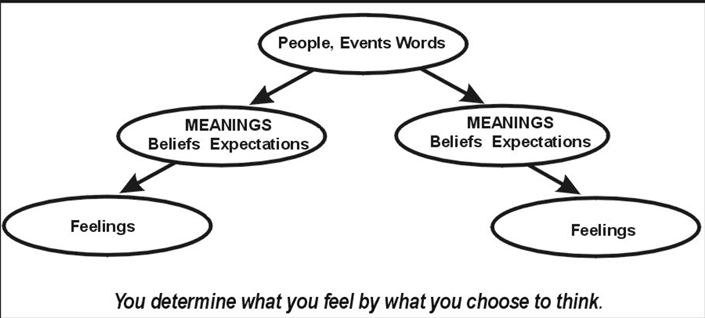
Thus, the occurrence of an event prompts you to create a concise interpretation, either consciously or unconsciously; the inference drawn determines your state of feeling, following which you thereby engage in a suitable course of action (behavior). Take a look at the diagram below, which depicts the sequence of events.

Consider the following example to gain a broader understanding of the concept: Your divorce is the current turbulent event in your life, and you are drawn to decide the inference(s) of the perceived event. Since you dictate your own beliefs, you’ve listed several possibilities as conclusive meanings for the event:
- I failed. I am a no-good loser. (Blame yourself)
- It is my spouse’s fault; she had an affair. (Blame others)
- She belongs to me! If I cannot have her, no one else will. (Threats and control)
- I am a great spouse. He/she is just too blind to see it. (Rationalization)
- Nothing is a failure if I learn from it. (Accept responsibility)
- I am going to dedicate myself to figuring out what went wrong so that I will not make the same mistake again. (Dedicate myself to growth and learning)
- None of the above (Make up your own meaning).
During an ongoing event, you will, consciously or unconsciously, attribute a specific meaning to it. While the predictability of our situational events may be beyond our control, the act of meaning attribution is within our conscious awareness.
Three ways our feelings can be changed:
1. A Cognitive Process. The process is characterized by a logical component using predominantly left-side brain approaches. Given below is an graphic illustration by Matt Perelstein, the founder of EQ4Peace.

Before using this chart, first make a list of all the emotions you believe might propel you toward a change. Then, using a separate chart for each event, examine specific situational events in your life and their relevance in terms of it’s meaning.
Consider an incident in which you felt extremely enraged. What was it about that particular event that made you so angry? What opinion did you have at the time? Perhaps it was “People should act in accordance with my heedful wishes, not what they insist on doing.” Looking at the belief statement, you recognize the urge for a transformative change of feelings. The process begins with the search for alternative belief(s), such as “What may be beneficial to me may not be mutually impactful to another.” Holding true to such a statement, you are required to look for evidence to validate the newly formed emotions associated with it.
When I was four years old, Mom and I rode the streetcar to downtown Sacramento. I had never seen so many people in one place, which left me quite in awe. I kept a keen eye to my surroundings and saw that at the points of intersection, when the policemen blew their whistle, the lights changed color! For several years, I believed that the policeman’s whistle had manifested great magical powers.
However, it is critical to regularly re-evaluate our beliefs, values, and opinions. Who knows? As an adult, maybe you’re still blowing your whistle and wondering why nothing ever worked for you.
2. An Affective Process. Some therapists are seen to solely rely on a cognitive-based model. If you’ve been seeing a therapist who only uses cognitive approaches and you’re feeling stuck during your sessions, you should consider switching to a therapist who uses right brain therapeutic techniques instead. The emotional orientation of the brain can result in a review of elicited flashbacks or images that may be associated with intermingled emotions, causing you to feel stressed or relaxed based on the retrieved image.
An affective therapist is inclined to use several different techniques, such as guided imagery, visualization, role-playing, Gestalt dream therapy, the empty chair technique and postural-induced affective metamorphosis, etc.
Since it seems implausible to discuss a logical argument with a retrieved mental image or flashback, the objective of these techniques is to merely alter the images that cause you unsurmountable distress. This is accomplished by juxtaposing a positive image with a negative image. Consider the metamorphosis of +1-1 = 0. Additionally, LSD has been tested in military medical studies to treat PTSD in service members by substituting the unpleasant flashback images that the veterans perceive in their minds with more pleasurable ones.
3. A Behavioral Process. Consider how a teacher might reward a child with an M&M chocolate in recognition of good behavior or how a boss might award extra bonus points to his employees at the end of the year. Despite research claiming that such techniques are ineffective long-term measures, such strategic behavioral reinforcement is frequently used in parent-child relationships and other common areas of our lives.
The behavioral therapeutic approach is most often associated with modifying negative feelings such as anxiety and fear. Have you ever watched a small child at the top of a steep-looking slide? The fear of falling is one of the two basic emotions that we inherit as a pre-dispositional human tendency. Consider for a moment if we had the ability to detach ourselves from a fear that we were born with. How does a parent help their child overcome such a fear?
You may not believe it, but the experience of fear begins by allowing yourself to do what you are truly afraid to do.
Try to recall your first day at a new job. At the time, what feelings were you experiencing the most? You might have felt more at ease after surpassing the initial few weeks. You may have felt less nervousness, anxiety, or rumination, which were constantly felt during your first week on the job. How would you relate to the sudden change of feelings?
We have been told more often than not that it has never been easier to change your feelings and therefore learn the art of suppression. Why suppress them, you may ask? because it is a true sign of human weakness, they say. However, this has not always been true. What we have learned (or, as some would say, relearned) in the last 60 years has made this all seem possible.
Ask these questions to yourself. Do you see yourself as an introvert? Do you see yourself standing up to face a crowd of 500 people and engaging in a conversation with them? I had a young lady tell me that when she was in high school, large public gatherings often made her nervous. “So, I told all my teachers to assign me projects where I had to get up in front of the class and talk!” Today, she stands out as one of the top salespeople in her field, travelling all over the world and speaking to large groups of people. Wouldn’t it be right to say that she has learned the art of mastering her own emotions?
Know that what you protect, you make weak!
Summary:
- You are the master of your thoughts.
- You always give meaning (i.e. your beliefs, values, and expectations) to what you see and/or experience.
- The meaning that you put on people, events, and words determines how you feel about yourself, others, and the world.
- You can only change your feelings if you are aware of your thoughts and their meanings.
- There are three techniques that can help you change what you feel, i.e., the cognitive processes, the affective processes, and the behavioral processes.
In the diagram below, look at the heading titled as “meanings.” Fill in the left-hand oval with your beliefs or expectations that are causing you distress. Whereas, in the right-hand oval, write down your beliefs or expectations that would give you the feelings that you would love to have.
Make a similar chart like the one shown below and post it on your refrigerator. The best way to engage in this activity is to remember that each serving you take from the refrigerator will help you nourish your thoughts by paying heed to them. Then, every day, repeat the same activity by including the beliefs, values, or expectations that you choose to have. At the same time, acknowledge and remind yourself of the positive mantra: “Your negative beliefs accomplish nothing for you except to make their presence known by making you miserable.”
Important:
Once you’ve discovered what meanings, beliefs, or expectations create the desired feelings within you, you’ll need to identify the reinforcing events in your life that affirm such newly founded beliefs.
Key points to remember :
- If you do not like what you are feeling, modify your thoughts (meanings, beliefs, or expectations).
- “You” are the source of change.
- You are “powerful” enough to change yourself, but “powerless” enough to change someone else.
Email: docdowning103@gmail.com
Durrani1906| aliyaharifdurrani@gmail.com|